How I supercharged My Work as CMO with Microsoft AI Tools — and Few Others
By Sami Sinkko, CMO, Sulava MEA
A lot has been written about AI and marketing. Most of it focuses on creating content faster.
That’s useful, but it misses the bigger picture.
As a CMO, my job isn’t just to produce content. I need to understand markets, make strategic decisions, build a consistent brand, support sales, communicate with stakeholders, and help the business grow. Content is only one piece of the puzzle.
Over the past year, I’ve gradually built an AI-powered way of working that touches almost every part of my role. The result hasn’t just been efficiency. I’ve genuinely become more effective.
Here’s what has worked for me.
First Things First: Build the Foundation
Many organisations start with AI tools. I think that’s backwards.
Before introducing AI into our marketing workflows, we invested time in getting our brand foundation right. We configured our visual identity, tone of voice, templates, logos, imagery, and brand assets so they were available across our Microsoft 365 environment.
We built standardised PowerPoint and Word templates and distributed approved assets through Org Asset Library. Teams backgrounds, logos, wallpapers, and brand imagery became accessible to everyone.
This sounds simple, but it’s one of the most important things we’ve done.
AI becomes dramatically more valuable when it has a clear understanding of your brand. Without a strong foundation, you simply produce off-brand content faster.
Microsoft 365 Copilot Has Become Part of My Daily Workflow
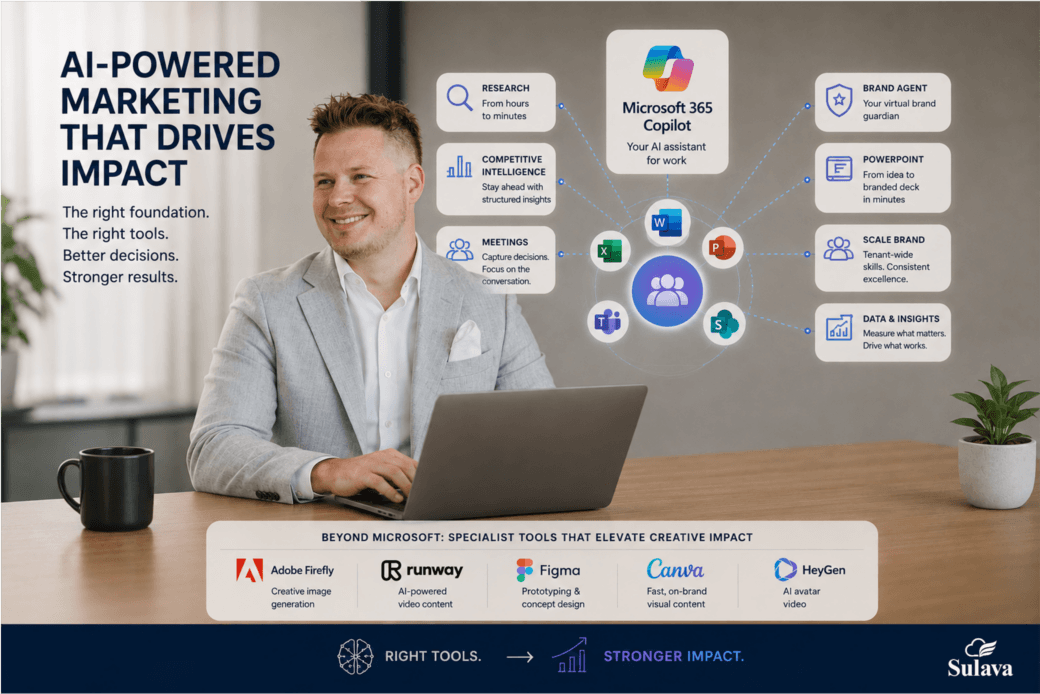
Microsoft 365 Copilot is the tool I use most frequently.
Whether I’m drafting emails, summarising documents, finding information buried in old conversations, or improving a piece of content before publishing, Copilot is usually my first stop.
The biggest benefit isn’t that it saves a few minutes here and there.
It’s that small productivity gains compound throughout the day. When dozens of routine tasks become easier, more time is available for strategic work.
Research Takes Hours Instead of Days
One of the biggest changes in my work has been how I approach research.
When preparing for customer meetings, evaluating opportunities, reviewing contracts, or analysing market trends, I rely heavily on AI-powered research capabilities.
What used to require hours of searching, reading, and summarising can often be completed in a fraction of the time.
More importantly, I can explore a topic more deeply than before. Instead of stopping when I run out of time, I can keep asking questions, challenge assumptions, compare viewpoints, and uncover insights that would have otherwise been missed.
As a marketer, better information almost always leads to better decisions.
Competitive Intelligence Has Become Far Easier
Modern marketing leaders need to stay informed about competitors, industry movements, customer expectations, and emerging technologies.
AI has significantly improved my ability to do that.
Rather than manually tracking dozens of sources, I use AI to gather, organise, and summarise relevant information. Industry developments, market trends, competitor activity, and new ideas arrive in a structured format that is easy to consume.
The result is that I spend less time searching for information and more time acting on it.
AI Helps Me Get More Value from Meetings
Like most leaders, I spend a significant amount of time in meetings.
Customer discussions, partner conversations, leadership meetings, vendor negotiations, internal planning sessions, and project reviews all generate important information.
Previously, I often found myself taking notes while simultaneously trying to participate in the discussion.
Today, AI helps capture key decisions, action items, and insights automatically.
That allows me to focus on the conversation itself instead of worrying about documenting every detail.
The quality of my participation has improved, and I rarely have to revisit lengthy meeting recordings afterwards.
Marketing Agents Help Protect Brand Consistency
One challenge every growing organisation faces is maintaining a consistent tone of voice.
The more people creating content, the harder it becomes.
To address this, I’ve built a dedicated Marketing Agent that understands our messaging, positioning, and communication style.
Before publishing content, I frequently use it to review language, improve clarity, and ensure consistency with our brand.
I don’t see this as replacing human creativity.
I see it as giving everyone access to a virtual brand guardian.
PowerPoint Has Changed More Than I Expected
One of my favourite capabilities is Copilot for PowerPoint.
Like many executives, I’ve spent years staring at blank slides trying to decide where to start.
Today, I can begin with an idea, a document, meeting notes, or a simple prompt and quickly generate a branded presentation draft.
Because our templates and brand assets are already in place, the output is usually aligned with our visual identity from the beginning.
Instead of spending hours building slides, I spend my time refining the story.
That’s a much better use of a CMO’s time.
Scaling Brand Excellence Across the Organisation
One of the most impactful initiatives we’ve implemented is tenant-wide skill configuration for presentation creation.
In practice, this means employees can generate presentations that follow our standards without needing advanced design skills or extensive knowledge of our templates.
Quality is no longer dependent on a small number of specialists.
Everyone has access to the same best-practice approach.
That level of consistency becomes increasingly important as organisations grow.
AI Agents Are Starting to Do Real Work
This is the area I find most exciting.
Many people still think of AI as a chatbot that answers questions.
The reality is that specialised agents are increasingly able to perform portions of the work itself.
Some assist with research. Others prepare content. Some gather information, monitor topics, or support decision-making processes.
I already use these capabilities regularly, and I believe this trend will accelerate rapidly over the next few years.
The organisations that learn how to combine human expertise with specialised AI agents will have a significant advantage.
Data-Driven Marketing Becomes Easier
One area that often gets overlooked is measurement.
Marketing leaders are expected to demonstrate business impact, not just activity.
AI-powered analytics tools help me understand campaign performance, identify trends, monitor engagement, and evaluate what’s actually working.
Instead of spending time manually compiling reports, I can focus on interpreting results and deciding what to do next.
For any CMO, that shift is incredibly valuable.
Beyond Microsoft
Microsoft provides the foundation for most of my daily work, but I also use specialist tools where they offer unique value.
Adobe tools like Firefly for creative image generation, Runway supports AI-powered video content. Figma remains my preferred platform for prototyping and concept development. Canva is excellent for fast visual content creation, and HeyGen enables realistic AI avatar videos. These tools complement the Microsoft stack beautifully when it comes to high-quality visual production.
Each tool has its strengths.
The goal isn’t to use more tools. The goal is to use the right tool for the right task.
What I’ve Learned
The most important lesson has been surprisingly simple.
AI is not a shortcut.
The organisations seeing the greatest value are the ones that first invest in their processes, assets, knowledge, and operating model. Once that foundation is in place, AI can amplify it dramatically.
For me, AI has changed how I create content, conduct research, prepare for meetings, analyse markets, build presentations, scale our brand, and make decisions.
But the technology itself isn’t the story.
The story is what becomes possible when people have access to the right information, at the right time, in the right format.
AI hasn’t replaced my judgement as a CMO.
It has amplified it.
If you’re exploring how to bring these capabilities into your own organisation, I’d be happy to share what we’ve learned along the way.
The Takeaway
The Microsoft AI ecosystem has meaningfully elevated my marketing work — from daily efficiency gains to strategic capabilities like tenant-wide brand scaling. The key was investing in the right foundation first, then layering in the tools.
AI doesn’t replace the CMO’s judgement — it amplifies it.
Want to hear more about how to deploy these capabilities in your organisation? Reach out — I’m happy to share what we’ve learned and help your team get started.